For a 44-year-old woman longing to become a mother, what is the best choice?
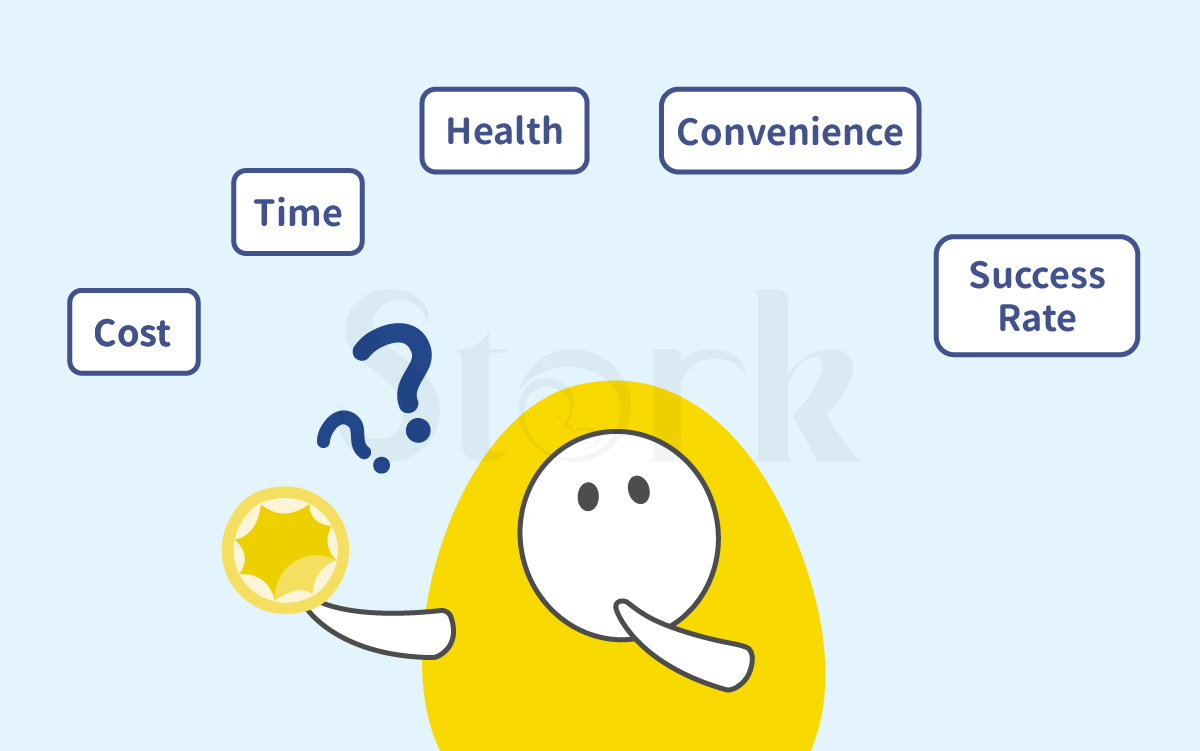
To answer this question, first you have to ask yourself: Which factor do you care about the most, cost, time, health, convenience, or success rate?
For the general public, it is hard to decide whether to receive egg donation because emotional factors keep lingering in their mind: the borrowed egg is not of my own genes. What if the baby doesn’t look like me? Will the baby be healthy? Will I love the baby as much as my own? What will my relatives say about this? There are thousands of reasons that keep them hesitant.
For reproductive doctors, it’s also a struggle. Besides being unable to provide precise data for client’s decision-making, most of them secretly desire to confine clients to "self-egg IVF," which sadly only wastes more time. I often ask oocyte recipient clients “how did you find Stork?" and everyone answered "I searched online by myself." I wonder, is it so hard for other doctors to guide their patients the right way with kindness and love?
Little Orange's mother was no exception. She spent at least millions of NT Dollars, exhausted almost all her fortune before she decided to accept donor eggs, and that is the journey most of the oocyte recipients went through. I suspect she also found Stork by herself. How do we break free from the myth and do the right thing from the start?
Stork's egg donation program is well-known to be "fast and best"
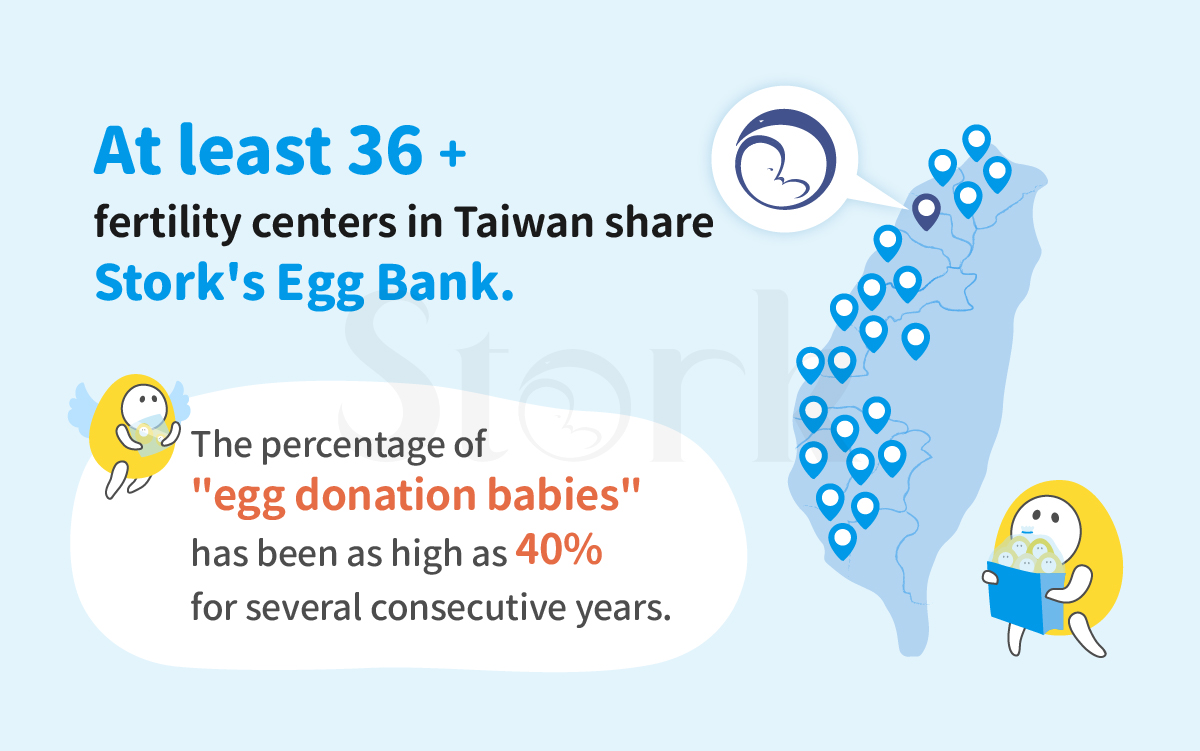
Clients from Taiwan's neighboring countries, such as Japan, China, Hong Kong, and Macau, all know that Stork's egg donation program is "fast and best." However, they might not know that at least 36 fertility centers in Taiwan share Stork’s Egg Bank, and the percentage of "egg donation babies" has been as high as 40% for several consecutive years.
You might wonder why an egg bank is so rare? The biggest reason is the huge initial cost. To stock 150 donors’ eggs, the costs are at least NT$50 million, including creating a digital platform for management, recruitment costs, health evaluation fees, stimulation fees, egg retrieval fees, egg freezing fees, nutrition subsidy, etc. The approximate cost for one donor is NT$200,000 in total. Another reason is the high "bad debt" rate during the first three years, as high as 20%. Among 100 donors, fewer than 50 persons pass the health evaluation.What’s more, we experienced canceled donations due to poor stimulation, lower-than-expected egg retrieval results, and poor fertilization/blastocyst culture rates after thawing (about 4%)... These "tuition fees" must be absorbed by the clinic itself. The third reason is the most difficult part, management. This requires a dedicated space and personnel to ensure 24-hour security control and liquid nitrogen refilling 2-3 times a week, not to mention various hidden costs. After all, this is a business with low demand and high cost, not able to make money in a short term, which is why no one is willing to do it.
The Cost of Repeated Attempts Using Self-eggs Vs. Egg Donation Program
If a client cares about cost, I provide them with my professional opinions: at age 44, out of every 7 blastocysts only 1 has normal chromosomes. To create 7 blastocysts at this age, it requires 28 eggs. If 2 eggs are retrieved each month, it takes 14 cycles to complete collecting enough eggs. If each cycle costs NT$200,000 to NT$300,000, bringing a healthy baby home costs at least NT$2.8 million to NT$4.2 million. Goodness! Wouldn't this require you to sell your house? Furthermore, among women aged 40 and above, 20% to 30% of them have a rather strong immune system. Imagine the shock if the immune system attacks the embryo after transfer and causes a miscarriage! In contrast, the cost of receiving egg donation is only one-fifth of the cost using self-eggs, and 30% of our egg recipients have embryos left after the first transfer so they can have a second baby. After hearing all this, if the clients are still hesitant about receiving donor eggs, I offer a heartfelt remark: "Earning money is not easy; don't throw your money away!" Most clients felt enlightened after hearing this and thanked me before they leave.
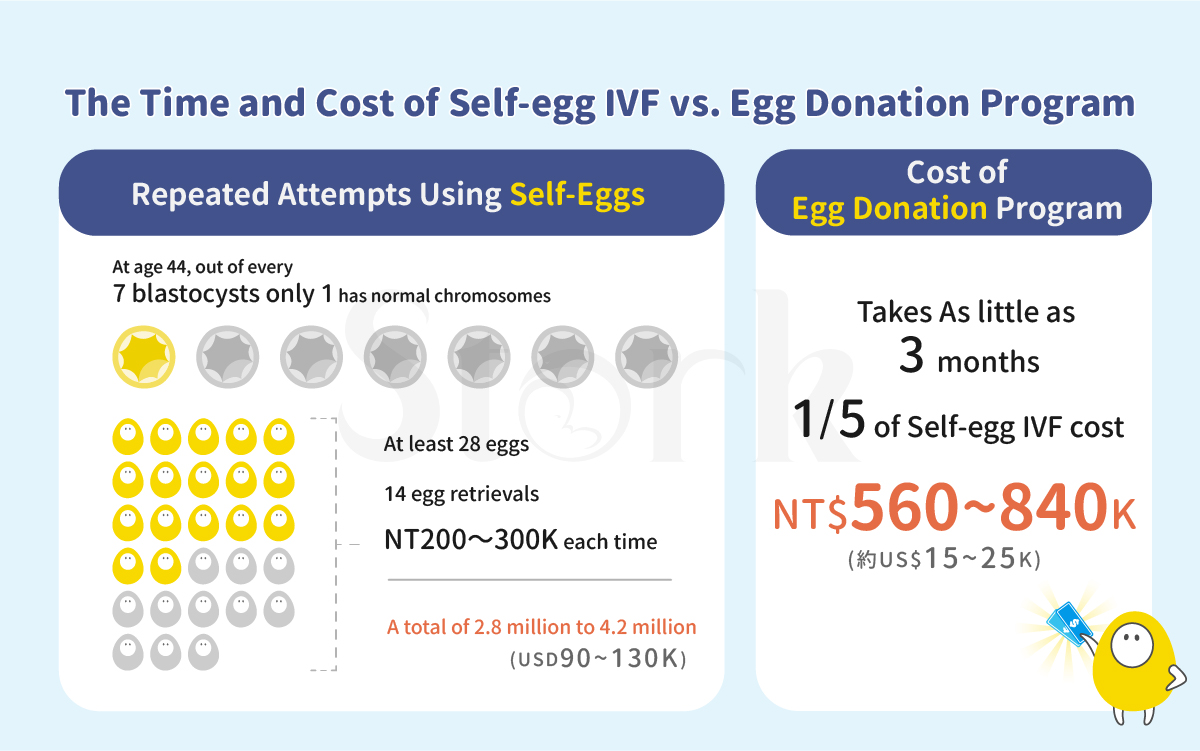
For me, time is the most expensive currency! Clients who care about time should also prioritize receiving egg donation. At Stork, the procedure from starting the egg donation program to completing implantation only takes as little as 3 months. Clients who care about health should consider egg donation even more. Stork strictly selects young donors (aged below 32) and have them done the chromosome screening and iGene testing to help filter out recessive hereditary diseases, such as the hearing loss gene (GJB2), which is carried by over 20% of Taiwanese people. Those who care about convenience and success rate need not be told. Stork’s Egg Bank guarantees the number of mature eggs (at least 10) and the number of good blastocysts (at least 3). If you live in the central or southern part of Taiwan, you can utilize Stork's high-efficiency intelligent laboratory, the "4SG Lab.," which means we thaw and culture blastocysts for you. You can then retrieve them to nearby fertility centers, eliminating the need to travel to Stork.
Although Little Orange's mother missed the window of egg freezing, she made a wise decision by choosing egg donation. Her courage to share positive energy is admirable. If you are still hesitant or have difficulty making a decision whether to receive egg donation, you can ask AI. As far as I know, it doesn't have "inner demons" and provides better answers than 80% of reproductive doctors.